
B2B go-to-market strategy for technical manufacturers in Latin America
Table of Contents
- What a B2B go-to-market strategy is, and why it matters here
- Who this guide is for
- Terms to know
- Why technical manufacturers underperform in Latin America
- Where expansion breaks down
- The seven parts of a go-to-market system
- How to build your plan, step by step
- What this demands from your team
- Questions for your leadership team
- FAQ

You make a better product. Your engineers can prove it. And in Latin America, you still lose projects to a cheaper brand that ships faster.
We've heard some version of that story many times. This guide is for the people who have to fix it: the CEO and the commercial and marketing leads of a technical manufacturer selling (or trying to sell) in the region.
It's built around 7 parts of a go-to-market plan that we've seen make the difference for manufacturers in HVAC, refrigeration, electronic security, and ProAV.
It draws on our work in those industries and recent conversations with technical product manufacturers and distributors. Every month we add a new article on one of the 7 parts.
What a B2B go-to-market strategy is, and why it matters here
A go-to-market strategy is your plan for selling to business buyers in a specific market. It answers 2 questions: who you sell to, and how you'll reach and convince them.
For a technical manufacturer, that second question is bigger than it looks. Gartner puts the typical buying group for a complex B2B solution at 6 to 10 decision makers. In technical categories, some of those people don't work for the buyer at all: the consultant who writes the spec, or the integrator who installs the system.
Then there's the geography. Latin America and the Caribbean total 33 countries, according to ECLAC. Each has its own channels and its own pace.
So a plan that worked in the US or Europe rarely transfers as is. You need to rebuild it around the people who decide, market by market.
Who this guide is for
It's written for a specific kind of company. You sell a technical product that's more expensive than the low-cost option, and you can justify the difference.
You already have some presence in Latin America: a distributor, a few reps, maybe a regional office. And your regional marketing resources are thin, often a single person covering the whole region.
If your regional marketing already works and your pipeline is healthy, some of this will feel familiar. That's fine. Several manufacturers we spoke with told us exactly that, and it sounded right for their situation.
Terms to know
These words show up throughout the guide. Their meaning shifts a little by industry, so here's how we use them.
- Specifier (or consultant): the engineer or designer who defines the technical requirements of a project, sometimes down to the brand.
- Integrator: the company that designs and installs a system, then supports it. Common in electronic security and ProAV. Often the one who recommends the brand.
- Installer or contractor: the company that puts the equipment in place, common in HVAC and refrigeration.
- Distributor: buys from the manufacturer and resells to installers and integrators. In many markets, it also holds stock and extends credit.
- Importer: brings product into a country and handles customs and local registration. Sometimes also the distributor.
- Rep or agent: sells on the manufacturer's behalf in a territory, usually on commission.
- OEM: a manufacturer that builds your component into its own product.
- Demand generation: everything that creates interest and qualified leads.
- Sales enablement: the materials and training that help your channel and your own team turn that interest into sales.
Why technical manufacturers underperform in Latin America
One region, many markets
Latin America gets drawn as one block on a sales map. It doesn't behave like one. Each country has its own channels and technical standards. And its own way of closing a deal.
In some markets your product reaches the end user through a national distributor. In others it passes through an importer and a local rep before a contractor ever sees it. A security camera that sells through IT channels in one country can sell through electrical wholesalers in the next.
Maturity varies too. One market asks about energy-efficiency ratings and integration with building management systems. Its neighbor still buys on price and availability.
Many people shape one purchase
In technical categories, the person who signs the purchase order rarely makes the final decision alone.
A consultant writes the spec. A distributor recommends what's in stock. An installer or integrator picks the brand they know how to configure.
A facility manager remembers which equipment failed last summer. Depending on the product, an OEM engineer may matter more than all of them.

Who carries the most weight changes by product, application, country, and channel. A go-to-market plan that only talks to the buyer misses most of the people who shape the decision.
A cheaper option is always on the table
In the markets we work in, a lower-priced alternative is almost always on the table. Often it's good enough on paper. Sometimes it comes with better inventory terms and faster delivery.
Part of that pressure is economic, and no campaign will erase it. If your distributor can't get stock or credit, or a project is decided on upfront cost alone, you'll lose some deals no matter what you say.
But a lot of it is perception. When an integrator can't explain why your product is worth more, the spec sheet becomes the only argument. And on the spec sheet, the cheaper option often looks the same.
Not every manufacturer has the same gap
Some manufacturers we spoke with have strong marketing teams and clear plans. Their campaigns and trade shows bring in steady leads. Their challenges lie elsewhere, in operations or material costs.
So we'd be wary of anyone (us included) who tells you every manufacturer in the region has the same problem. The useful question is narrower: which of the 7 parts below is weakest for you, in which market?
Where expansion breaks down
These are the patterns we see most often when a technical manufacturer's growth in Latin America stalls:
- Running one strategy and one message across countries that buy in very different ways.
- Competing on spec sheets while a cheaper brand competes on price, and letting the buyer decide they're equivalent.
- Training installers and integrators, then letting that knowledge disappear instead of turning it into content the channel can reuse.
- Finishing good projects without documenting them, so sales has nothing concrete to show the next prospect.
- Investing in brand awareness without giving people a reason to prefer you once they know you.
- Talking only to the buyer and ignoring everyone who influences them, from the specifier to the installer.
- Splitting execution across local agencies with no one connecting the pieces.
- Generating leads before distributors and reps have the materials to follow up.
Each of these has a fix. None of the fixes work in isolation, which is why we think about go-to-market as a system.
The seven parts of a go-to-market system
Here's how we break it down. The parts feed each other. Awareness without differentiation goes nowhere, and proof from finished projects strengthens every other part.
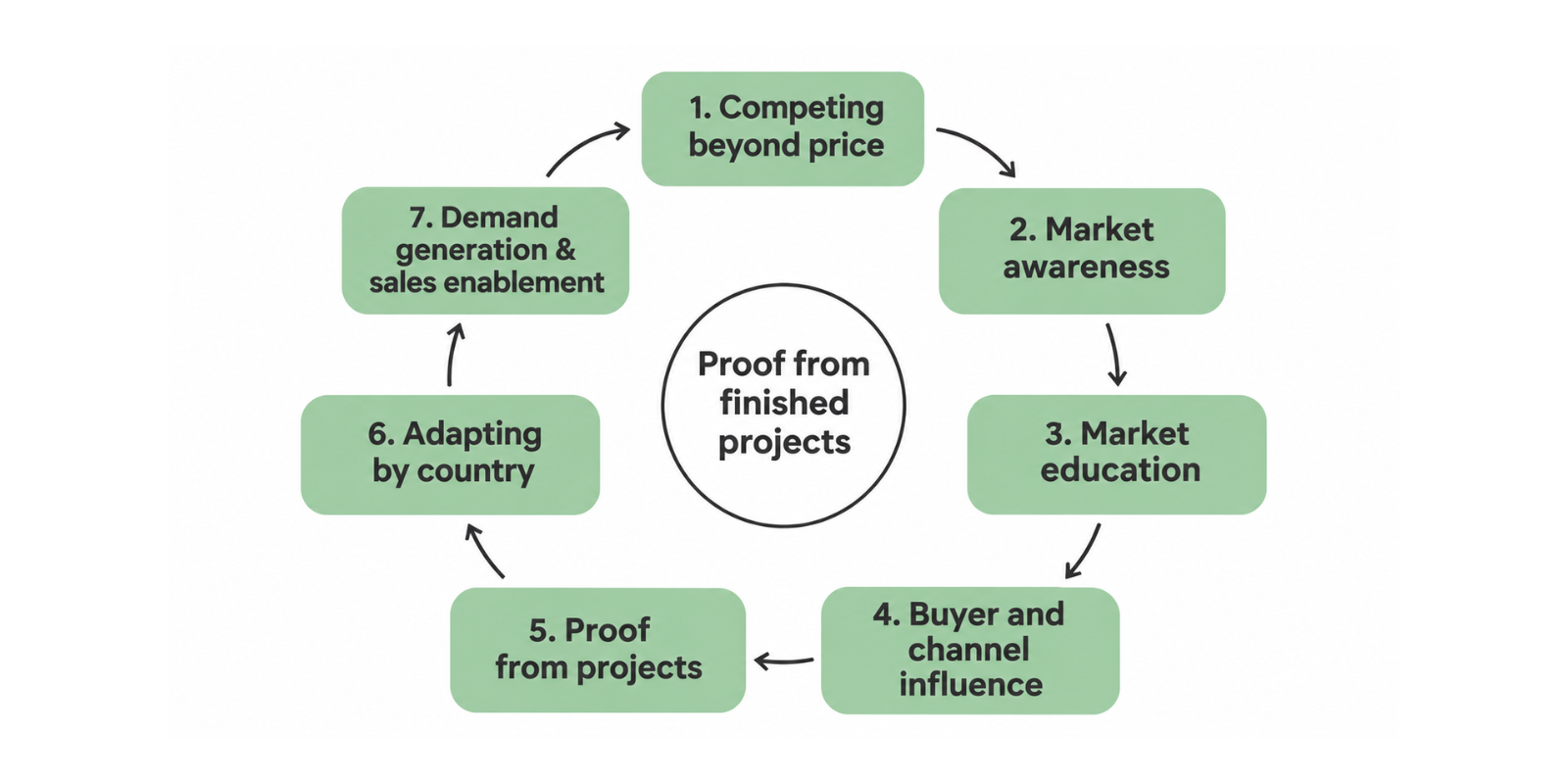
1. Competing beyond price
A question we hear from commercial directors across the region: why do we keep losing to cheaper brands when our product is better? Usually because the extra value is real but invisible to the person deciding.
A premium HVAC manufacturer may offer lower energy costs and fewer failures. A premium access control brand may offer better firmware support and fewer callbacks. If the integrator or distributor can't see those benefits, they won't pay for them.
Bain's research on what B2B customers value supports this. In a 2018 Harvard Business Review article, its authors identified 40 elements of value.
They argue that as B2B offerings become more commoditized, the less objective elements gain weight. They write that recognizing them is critical to avoiding the commodity trap.
We believe a sustained communication program can make that value visible. When distributors, installers and integrators understand what they gain beyond the equipment (support, training, fewer warranty claims, a brand their own customer trusts), many will choose the more expensive option. The program has to run for months and speak to each of those people in their own terms.
Coming in November: Competing on price? How technical manufacturers prove their value
2. Market awareness
Many of the manufacturers we talk to already do the visible things: trade shows, LinkedIn, industry associations, some paid media. And many still want more recognition in Latin America.
Awareness in a technical category has a specific job. The right people need to know what you're good at, and remember it when a project comes up. For a distributor, being known for service and engineering support can matter as much as the brands it carries.
Awareness without a clear differentiator tends to stall. People know your name and still pick on price.
Trade media and PR help most when they carry a clear point of view about that difference. Our quick guide on public relations for B2B brands covers the basics.
Coming in December: Why brand awareness doesn't always turn into preference for technical manufacturers
3. Market education
Technical products sell when people understand them. That includes the end customer, especially the installers and integrators who install and maintain them.
One manufacturer gave a pointed example: installation errors in the field turned into equipment failures and warranty claims. The gap was in what the installers knew. We also heard that technicians value a person they can call more than a video they don't have time to watch.
Education looks different by industry. In HVAC, it might be zoning and controls, or the move to new refrigerants. In electronic security, it might be configuring video analytics or integrating access control with other systems.
In ProAV, getting control systems and displays to work together in a meeting room. The common thread: training you already deliver can become content and sales material.
Coming in January: Market education: turning technical knowledge into commercial growth
4. Buyer and channel influence
Who actually decides which brand gets installed? It depends. In some HVAC projects, the consultant's spec decides. In small commercial jobs, the contractor does.
In electronic security, the integrator often has the final word, because they'll configure and support the system for years. In ProAV, an AV consultant may define the design, while the integrator picks the brands.
Mapping that influence, market by market, tells you where to spend. A campaign aimed at end users won't help much if the integrator is the one choosing.
Coming in February: The hidden decision-makers: how integrators and specifiers influence B2B sales
5. Proof from finished projects
Every completed installation proves your product works in this market, under these conditions, for this kind of customer. Most of that evidence never leaves the project folder.
One manufacturer described the problem well: the thread between the first lead, the project, the case study, and the content that could come out of it gets lost along the way. It has no owner.
A documented project in Bogotá or Monterrey does more for a hesitant distributor than any brochure. It answers the question they're really asking: has this worked for someone like me?
Coming in March: From finished projects to sales opportunities: how to use case studies in B2B
6. Adapting by country
Which market first? Market size is the obvious filter. Channel maturity and how long it takes to earn trust deserve at least as much weight.
Once you've chosen, the plan has to adapt. The messages and partners that work in Mexico may not work in Colombia or Central America.
Language needs the same care. Word-for-word translations of technical material tend to lose the reader, so review our B2B technical translation guide before you localize manuals or training.
Some manufacturers expand through local importers; others appoint country agents who buy product and parts directly. Both can work. They need different support.
Scaling means treating the region as a portfolio of markets, each with its own stage and plan.
Coming in April: Why one go-to-market plan doesn't work across Latin America
7. Demand generation and sales enablement
Leads are the visible part. What happens after is where many plans break.
Demand generation in technical B2B markets mixes offline and digital campaigns, outbound, trade shows and channel partners. Distributors and integrators can become your best source of pipeline, if they have what they need to sell: clear messages, technical answers, references and someone to call.
Sales enablement closes that gap. It turns marketing into tools your distributors and your own sales team use in real conversations.
Coming in May: Demand generation and sales enablement for technical manufacturers
How to build your plan, step by step
You don't need to fix all 7 parts at once. Here's the order we'd follow.
Step 1. Pick 1 or 2 priority markets. Choose based on channel maturity, how long it'll take to earn trust, and market size. A smaller market with a strong distributor can pay off sooner than a big one where you start from zero.
Step 2. Map who influences the purchase there. For each market, write down who specifies the product and who installs it. Then talk to 5 or 6 of them before you plan a single campaign.
Step 3. Write down why you're worth more, for each of those people. The distributor cares about margin and fewer returns. The integrator cares about fewer callbacks and a system that works the first time.
Step 4. Take stock of what you already have. Training sessions, technical guides, finished projects, presentations from your engineers. Many manufacturers have more material than they think, scattered across teams.
Step 5. Pick your weakest part and plan 90 days around it. Use the questions below to find it. One part done well for a quarter teaches you more than 7 parts started at once.
Step 6. Equip the channel, then measure conversations. Give distributors and reps what they need before you push leads to them. Track conversations and qualified opportunities first; traffic and likes come second.
What this demands from your team
Agreement at the top. Your leadership team needs one shared view of which markets matter and what success looks like in year 1. When those views differ, regional plans stall, even with budget behind them.
Local knowledge. Someone on the team (or close to it) has to understand the buyers and competitors in each priority market. A global playbook without that knowledge misreads the market.
Connected pieces. Messages, channels, training and sales support have to be planned together. Improving one in isolation gives you less than you'd expect.
Patience. Trust takes time to build with distributors and integrators, and short campaigns rarely move them.
In our experience, manufacturers that pull back after a slow quarter end up starting over later, at a higher cost.
Questions for your leadership team
Use these to find your weakest part. Answer honestly. This stays between you and your team.
If you answered "not sure" to 3 or more, that's probably where to start.
Table of Contents
- What a B2B go-to-market strategy is, and why it matters here
- Who this guide is for
- Terms to know
- Why technical manufacturers underperform in Latin America
- Where expansion breaks down
- The seven parts of a go-to-market system
- How to build your plan, step by step
- What this demands from your team
- Questions for your leadership team
- FAQ
FAQ
How is going to market in Latin America different from the US or Europe?
The region is a group of markets with different channels and buying habits. Distributors and installers often carry more weight in the decision, and trust built through people and references matters a great deal. A plan built for one market usually needs adapting for each of the others.
Can marketing really help a premium brand compete against cheaper alternatives?
Yes, within limits. A sustained communication program can make the extra value visible to decision-makers, and many will pay more once they see it. It won't fix inventory or credit problems, and some projects will always be decided on upfront cost.
How long does it take for a go-to-market plan to show results?
It depends on the market and the part you're working on. Equipping an existing distributor can show results within a quarter. Building recognition in a new country usually takes longer, and we'd plan for at least a year.
Where should a manufacturer start?
Start with the weakest of the 7 parts in the market that matters most to you right now. The questions above are a good way to find it.
Sources
- Gartner, "The B2B Buying Journey": gartner.com/en/sales/insights/b2b-buying-journey
- Almquist, E., Cleghorn, J. and Sherer, L., "The B2B Elements of Value", Harvard Business Review, March-April 2018. Summary at Bain & Company: bain.com/insights/the-b2b-elements-of-value-hbr
- ECLAC, Member States and associate members: cepal.org/en/about/member-states-and-associate-members
The short version
Your product's extra value counts only when the people who choose it can see it in each market where you sell.
About Signalis Group
Signalis Group helps technical manufacturers grow in Latin America. We work with manufacturers and distributors in HVAC, refrigeration, electronic security, and ProAV, connecting market awareness, channel education, PR, content, and sales support into one go-to-market plan.
We usually work alongside teams that already exist: your regional marketing lead and your current agency. Our job is to fill the gaps and connect the pieces.
Planning to grow in Latin America? Let's talk through where your go-to-market plan is solid and where it's thin. 30 minutes, no pitch deck.
Our Blog
--------- Learn more and take action for your business ---------

The Importance of ROI in B2B Content Marketing
In the B2B content marketing environment, measuring and optimizing return on investment (ROI) is essential to justify content marketing efforts.

Navigating Cultural Variations in B2B Marketing
International B2B marketing presents unique challenges and opportunities when operating across multiple regions and cultures.

Automation and personalization: nurturing leads in B2B marketing
Lead nurturing is the process of building relationships with prospects over time. In the B2B context, purchasing decisions can involve different parts and extensive sales cycles, so keeping the interest and interacting with potential buyers is vital.